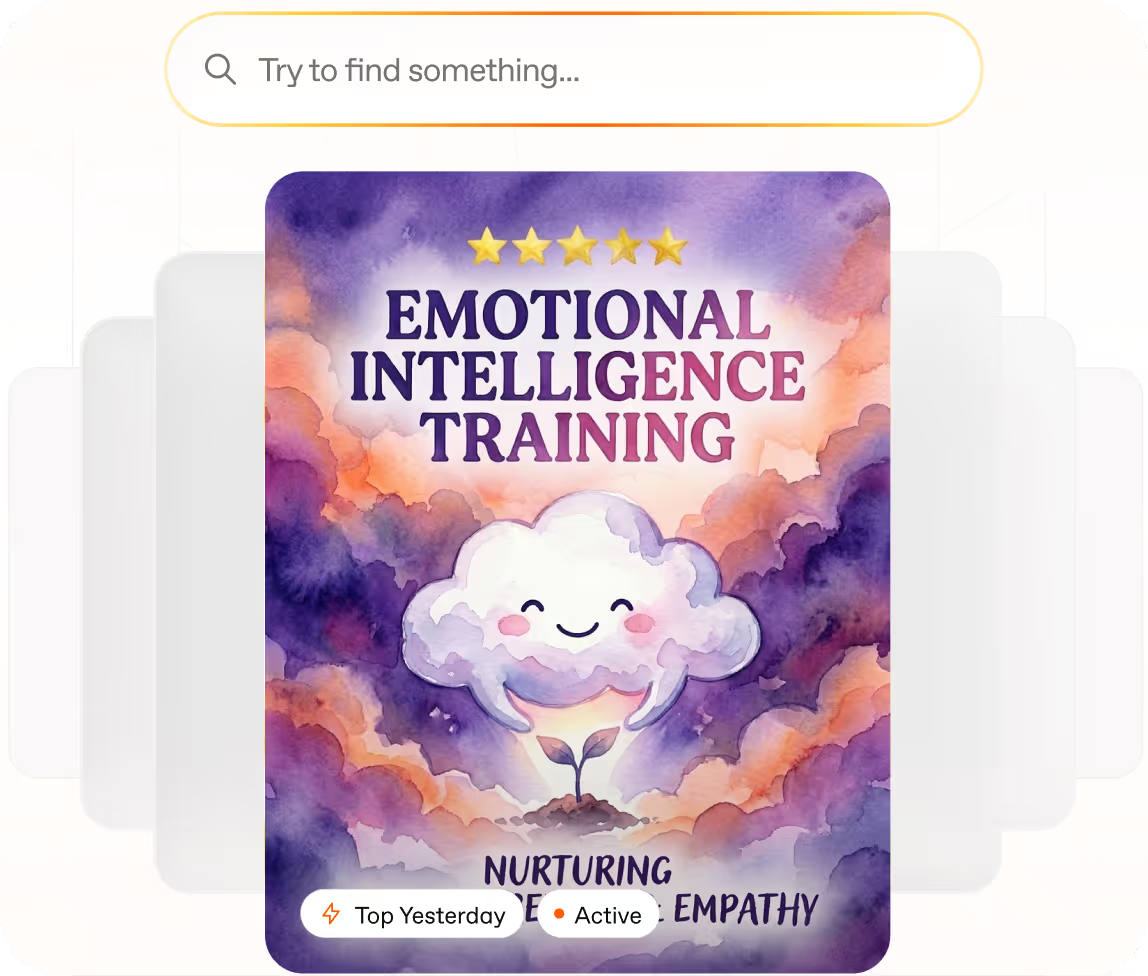
How AI Helps Marketers Find Winning Ads Faster [App Campaigns]
AI is becoming increasingly common across the advertising workflow, from generating creative concepts to analyzing campaign performance.
As marketers produce and test more variations, AI handles the parts of the process that are difficult to manage manually at scale. Instead of starting every test from scratch, marketers can use AI to narrow down what is worth testing, turn promising ideas into new variations, and learn faster from the results.
This guide explains how AI helps marketers find winning ads faster and how to build a workflow that turns each testing round into better creative decisions.
Key takeaways
- A winning ad needs to drive ROAS and scale
Look for ads that generate a strong return on ad spend (ROAS) and continue to perform as you increase spend, then identify the creative elements behind that performance. - Ad research can take more time than expected
Marketers often have to search across multiple platforms and sift through large volumes of material before finding relevant ads. - Only a small share of ads become winners
Creative performance follows a power-law distribution, with around 3% of ads driving 80% of revenue for most mobile apps on Meta. This makes improving your ad win rate a key part of scaling paid growth. - Competitor research and performance data serve different purposes
Competitor ads can provide ideas and creative patterns to explore, while your own account data shows which approaches are actually driving results for your audience. Use both to inform what you test next. - Spiral brings the winning-ad workflow into one platform
Spiral combines ad research across Meta and TikTok with AI creative production, performance analysis, and campaign launch, helping app marketers move from finding an idea to testing it faster.
What is a winning ad?
A winning ad is a creative that meets a predefined performance threshold for the metric that matters to your app, such as cost per acquisition (CPA) or ROAS, at a meaningful level of spend.
For example, you might define a winner as an ad that achieves a CPA below $N or a ROAS above X% after reaching $Y in ad spend.
The exact thresholds vary by app, business model, and campaign, but the principle is the same: set a clear performance target and minimum spend level before deciding whether an ad is a winner.
An ad that looks great at $50 a day can fall apart at $500 because performance at a small spend level doesn't necessarily predict how the creative will perform once it reaches a larger or different audience. Real winners keep performing as more people see them.
Every ad has a few core building blocks:
- Hook: The opening line, image, or first few seconds that earns attention.
- Angle: The specific way the ad presents the problem, benefit, or reason to choose the product. The same product can be marketed from very different angles depending on what matters to the audience.
- Concept: The central creative idea that brings the hook and angle together.
- Format: The way the idea is delivered, such as a static image, short-form video, carousel, or user-generated-style creative.
What makes a winning ad is how well those elements work together. Breaking an ad down this way makes it easier to test individual elements, identify repeatable patterns, and build a winning ad around what works.
What makes the ad testing process so time-consuming?
Finding winning ads and recreating them takes time because the traditional process is mostly manual. Someone has to dig through ad libraries, screenshot what looks good, brief a designer, wait for the files, upload everything by hand, and then wait for results.
Here's where the hours usually go:
- Research: Finding useful inspiration takes time because ad libraries contain huge volumes of assets across different formats, audiences, offers, and angles. Marketers have to sift through that volume to find relevant ads, and this is often the most time-consuming step.
- Production: Creating new hooks, visuals, formats, and versions can quickly turn each testing round into more design and production work.
- Setup: Uploading creatives and building campaign structures by hand eats into the time better spent on strategy.
- Analysis: Pulling metrics from campaigns and comparing results takes time, especially when marketers are testing multiple creatives at once. They also have to interpret the numbers and work out which elements contributed to an ad's performance before deciding what to test next.
The result is a slower testing cycle, fewer creative variations tested within the same timeframe, and more budget and resources spent on each round.
How AI helps marketers find winning ads faster
Finding promising ads can seem straightforward until you actually have to do it. There is no obvious place to start, and the volume of content makes useful examples easy to miss.
Even when marketers find something worth studying, inspiration can quickly turn into a production treadmill: One promising ad leads to a handful of variations, then those variations stop working, and the search starts again.
The problem is not a lack of material to look at. It is turning a huge, fragmented pool of ads into a focused shortlist of ideas worth testing.
AI can help address each of these bottlenecks by helping you research competitors, spot patterns, and learn from your own performance data.
Here's how:
Researching ads at scale
AI can scan large ad libraries and surface relevant creatives, turning hours of manual research into minutes. Instead of scrolling through feeds, you can browse organized collections of ads across platforms such as Meta and TikTok, filtered by app, category, or format.
That gives teams more time to evaluate ideas, draw inspiration, and come up with their own takes.
Spotting trends early
Modern AI can flag emerging creative patterns before they become widespread. Finding a competitor's new angle early gives you time to test the underlying idea before the market becomes saturated.
Tracking which apps are scaling can provide another useful signal. If a fast-growing app continues running similar ads, it may indicate that the format or concept is delivering results.
Finding the patterns behind performance
AI can analyze large groups of ads and break them down into elements such as hooks, concepts, formats, and emotional appeals, then surface patterns across them.
For example, if several strong ads in your category use a problem-focused opening and a real person on camera, AI can flag that combination as a recurring pattern and surface other ads that use similar approaches.
This helps you understand what winning ads have in common while also making it easier to find more relevant ads to research and test.
What happens after finding winning ads
Finding promising ads is only the first step. Once you have a creative worth exploring, the next challenge is turning that insight into new tests and learning from the results.
Creative performance tends to follow a power-law distribution, where a small share of ads generates a disproportionate share of revenue. For example, for most mobile apps advertising on Meta, around 3% of ads drive 80% of revenue.
That means producing more ads doesn't automatically mean producing more winners. The goal is to improve your ad win rate by using performance data and creative patterns to make each round of testing more informed.
AI can help marketers move from research into production and performance analysis in two ways:
1. Speeding up creative production
AI can turn a promising concept into multiple testable variations without requiring a full production cycle for each one. You can create new static ads, change characters or visuals, adapt copy for different markets, and remix existing concepts much faster.
That makes it easier to test more variations and learn which creative directions are worth developing further.
2. Learning from your own account
AI can connect to your ad account and analyze which creatives are driving ROAS, CTR, and CPA. Competitor research can show you what is worth testing, while your own performance data shows what's working for your audience.
Combining the two gives you a clearer basis for deciding which ads to iterate, which to retire, and which creative directions to test next.
How to introduce AI into your ad testing process
AI works best when it becomes part of the existing process, not a separate workflow.
You can use it to find relevant ads, identify patterns, recreate promising ideas, and learn from each round of testing, while keeping human judgment where context and brand knowledge matter most.
A simple workflow could look like this:
- Research: Collect ads from competitors and scaling apps in your category.
- Find patterns: Group them by hook, angle, concept, and format. Look for ideas that appear repeatedly across strong creatives.
- Create: Turn those patterns into a batch of new variations rather than recreating any one ad.
- Launch: Get the new creatives live quickly enough to generate useful performance data.
- Review: Look at which ads performed best, identify the creative elements behind that performance, and use those findings to shape the next batch.
The value comes from the loop. Each round gives you more data on what works for your audience, making the next round of research and testing more focused.
How Spiral helps you find winning ads faster
Spiral is a creative AI platform for growing apps that brings ad research, creation, and launch into one workflow.
Instead of searching across multiple platforms and saving ads manually, Spiral puts relevant creatives in front of you so you can discover, explore, and compare ads in one place.
You can use that research to spot patterns, find ideas that are worth testing, and build a stronger starting point for your own creative strategy.
Here's how the platform takes you from finding ads to recreating them in one go:
- Explore ads across Meta and TikTok: Discover winning hooks, angles, and concepts in a visual library, then save and share collections with your team.
- Catch trends early: Track which apps are scaling and spot competitor ads that are gaining momentum.
- Generate AI static ads and scale video: Turn winning concepts into test-ready variations. Remix, translate, swap characters, and edit videos at scale.
- Know which ads to iterate: Connect your Meta ad account to see ROAS and key metrics, then build on your top performers.
- Improve your win rate: Get clear answers on which ads work, why they work, and what to create next. AI tags that break down ads by hook, concept, and emotion are coming soon.
- Launch faster: Set up your Meta structure and bulk upload campaigns straight from Spiral.
Ready to find your next winning ad? Get started with Spiral today and see how much faster idea testing can be.
FAQ
Is it okay to take inspiration from competitor ads?
Yes. However, it's important to distinguish between taking inspiration and copying. Use successful ads to identify ideas that may work for you, then build your own assets around your product, audience, and brand rather than copying their assets or messaging.
What is creative fatigue, and how do I spot it?
Creative fatigue happens when your audience has seen an ad so many times that it stops working. The usual warning signs are a falling CTR, a rising CPA, and a climbing frequency, which is the average number of times each person sees your ad.
If a former top performer starts sliding on all three, it's time to refresh it with a new hook or format.
Should I research AI-generated ads and UGC-style ads separately?
Not necessarily. If you're trying to find winning ads, it's useful to look across different creative formats and styles rather than limiting your research to one type. AI can help you search through and compare a wider range of creatives, from static and video ads to UGC-style content, and identify patterns that appear across strong performers.
Spiral supports both AI-generated static and video ads and UGC created by real creators, so you can take a promising idea from research into different formats.
What signals should I look at when researching an app's ads?
Creative quality is only part of the picture. Other useful signals include estimated downloads, estimated revenue, EU reach (unique impressions in Europe), and the number of active ads on Meta and TikTok.
On Meta, a page's impressions ranking can also provide context on how much visibility an app is generating compared with other advertisers.
Why do changes in these signals matter?
A single data point gives you a snapshot, while changes over time can show whether an app or its advertising activity is gaining momentum. For example, rising estimated revenue or downloads alongside increasing EU reach or a growing number of active ads can indicate that an app is scaling.

%20(1).avif)

.svg)